To raise prices without losing clients, increase by 5–10%, give existing clients four to six weeks' notice, tell your regulars in person before they read it in a message, and let every appointment that is already booked keep its old price. New clients pay the new price from day one. The number matters less than how and when you say it.
This guide is written for any business that sells appointments: salons, barbershops, nail and lash studios, spas, massage and tattoo studios, personal trainers and repair shops. The examples use a $40 service; swap in your own numbers.
Why does a small price increase matter so much?
Because price moves profit faster than volume does. McKinsey found that for the average S&P 1500 company, a 1 percent price rise with volumes unchanged produced roughly an 8 percent increase in operating profit (McKinsey Quarterly, 2003). A small service business has different costs, so your number will differ, but the direction is the same.
Many owners wait years to raise prices because they fear losing clients. The next section shows how many you can actually afford to lose.
How many clients can you lose before a price increase costs you money?
Divide the increase by the margin plus the increase. The margin is the share of each sale left after the costs of delivering it: products, staff commission and card fees. That gives you the break-even point: the share of clients you can lose before you earn less than you do today.
Take a $40 service with $4 of product and $16 paid to the staff member as a fixed amount per service. That leaves $20, a 50% margin. A 10% increase makes the price $44 and, with those costs unchanged, leaves $24. You break even if you lose 16.7% of those clients, about one in six: 10 ÷ (50 + 10).
| Margin per sale | 5% increase | 10% increase | 15% increase |
|---|---|---|---|
| 30% | 14.3% | 25.0% | 33.3% |
| 50% | 9.1% | 16.7% | 23.1% |
| 70% | 6.7% | 12.5% | 17.6% |
The table shows the share of clients you can lose before profit falls. It treats rent and salaries as fixed, and assumes your costs per sale stay the same in dollars when the price goes up. If staff commission is a percentage of the price, it rises with the price and your real break-even is a little lower. It works best for one service at a time. If you are booked out, a client who leaves is replaced from your waitlist and the real cost is lower; if you have empty hours, it is higher. Use your own margin: staff commission is usually the biggest variable cost.
When is it time to raise your prices?
Any one of these signs is enough, and two or more means you are overdue. The strongest signal is demand: if you are booked out weeks ahead or turn people away, your price is doing less work than your calendar.
- You are booked two to three weeks ahead, or you regularly turn people away.
- You have not changed your prices in 12 months or more.
- Rent, products or supplies cost more than when you last set your prices.
- You have added skills, training or equipment since the last change.
- No client has ever hesitated at your price.
The last one is the easiest to miss. If nobody ever pauses at the price, you are probably below what your market will pay.
How much should you raise prices?
Most salon pricing guides land on 5–10% a year. Vagaro suggests 5–10% every year to year and a half, Booksy says no more than 10% at once, and Zenoti suggests 8–12% at an annual review. Round to clean numbers: $44, not $43.60.
After two or more years without a change you may need 15–20% (Zenoti's range). Do it in two steps six months apart instead of one jump; two small changes usually land better than one big one. Raise your most-requested and hardest-to-book services first, and keep your entry-level service close to where it is, so a new client can still say yes.
Who pays the new price, and from when?
New clients pay the new price from their first booking. Existing clients pay it after your notice period. Appointments that are already booked keep the price they were booked at. Pick one rule, write it down and say it out loud, so nobody feels tricked.
| Who | New price applies from | What to do |
|---|---|---|
| New clients | Immediately | Update your price list and booking page first |
| Existing clients | After the notice period (4–6 weeks) | Tell them in person, then send a message |
| Appointments already booked | Never: they keep the booked price | Say so in the announcement |
How much notice should you give?
Give regular clients four to six weeks, and six to eight for a larger increase. Booksy recommends at least a month, Vagaro suggests six weeks and Zenoti four weeks as a minimum. A month is about one visit cycle, so most regulars hear it in person before the date.
- 6 weeks before: finish your new price list, choose the soft landing (below) and tell your busiest regulars in person.
- 4 weeks before: send one message to everyone on the channel they answer, usually WhatsApp, SMS or email.
- 2 weeks before: send a short reminder and put the new list on your booking page and at the front desk.
- Effective date: the new prices apply to every appointment booked from that day on.
If your calendar opens months ahead, limit the old price to appointments that fall inside the notice period, or someone will book six months out at the old price.
Should loyal clients keep the old price for a while?
A short soft landing is cheap and builds goodwill; an open-ended one leaves you running two price lists. Choose one option, give it an end date and offer it only to clients who earned it.
| Option | What it costs you | Best for |
|---|---|---|
| One more visit at the old price, for clients with more than three visits in the last 12 months (Zenoti's suggestion) | One discounted visit per regular | Salons and barbershops with frequent visits |
| Book or prepay before the date (Booksy's suggestion) | Cash arrives earlier, a few visits at the old price | Packages and long services |
| Old price on one service for three months | Small and time-limited | Your longest-standing clients |
Write the promise down where the whole team can see it, for example as a note on the client card, so it is honored by whoever is at the desk.
What should you say? Word-for-word scripts
Say it once, say it early and keep it short. State the date and the new price, thank the client and offer the soft landing. Do not apologize and do not over-explain: a long justification invites a negotiation.
| Situation | What to say |
|---|---|
| Message to all clients (WhatsApp, SMS or email) | "Hi [Name], a quick note before your next visit. From [date], our prices are updating: [service] will be $[new price] (now $[old price]). Anything you book before [date] stays at today's price. Thank you for choosing us. See you soon!" |
| In person | "Just so you hear it from me first: our prices go up on [date]. [Service] will be $[new price]. If you'd like to book your next visit now, it stays at the current price." |
| If a client pushes back | "I understand, it's a change. [Service] goes from $[old price] to $[new price], and it reflects the products, training and time that go into your appointment. If you book before [date], you'll still get today's price." |
| On your price list and booking page | "Prices effective from [date]. Appointments booked before this date keep their price." |
Do not apologize, do not offer a private discount on the spot, and do not quote different prices to different clients without a reason you would be happy to explain. Word spreads, and a price list only works if it is the same for everyone.
What else can you do besides a blanket increase?
You do not have to raise everything at once. If you worry about losing clients, change the parts of the price list where demand is strongest and give price-sensitive clients a way to stay.
| Lever | How it works | Works best when |
|---|---|---|
| Raise only your most-booked services | Leave entry-level services close to where they are | A few services fill most of the calendar |
| Tiered pricing by experience | Different prices for junior, senior and master for the same service | Your team has different levels of experience |
| Replace discounts with rewards | Keep list prices and reward repeat visits with loyalty points or packages | You discount often |
| Paid add-ons | Offer extras clients can add or skip: a treatment, a longer session | Clients ask for more time or extras |
| Price by time, not by name | Charge for the extra time long or complex jobs take | The same service varies a lot in duration |
What should you track after the increase?
Track four numbers every week for 8 to 12 weeks: appointments booked, clients who rebook, average ticket and cancellations. If revenue is up and your regulars are still coming, the increase worked, even if a few clients left.
Expect a short adjustment period. Zenoti's salon guide reports fewer than 5% of regular clients leaving after a well-handled increase, with cancellations rising briefly and settling within four to six weeks. That is one vendor's benchmark, not a promise, so compare against your own numbers from before the change. If regulars do leave, a short personal message works better than a blanket discount; here is how win-back messages work.
What mistakes cost clients?
The mistakes that cost the most clients are rarely the increase itself. They are how it arrives: with no notice, through someone else, or wrapped in an apology.
- Surprising people. A new price on the receipt is the fastest way to lose a regular.
- Apologizing or over-justifying. It tells the client you doubt the price.
- Changing the price of appointments already booked. Honor the price they were booked at.
- Quoting different prices to different people. Word spreads.
- One big jump after years of silence. Split it into two steps.
- Discounting right after the increase. It tells clients the old price was the real one.
- Letting staff improvise. Give the whole team the same script before you announce.
Where does booking software help, and where does it not?
Software cannot announce the increase for you, but it can keep your prices consistent and make a soft landing easy to honor. Everything above works with a notebook or a spreadsheet too; software just removes some of the friction.
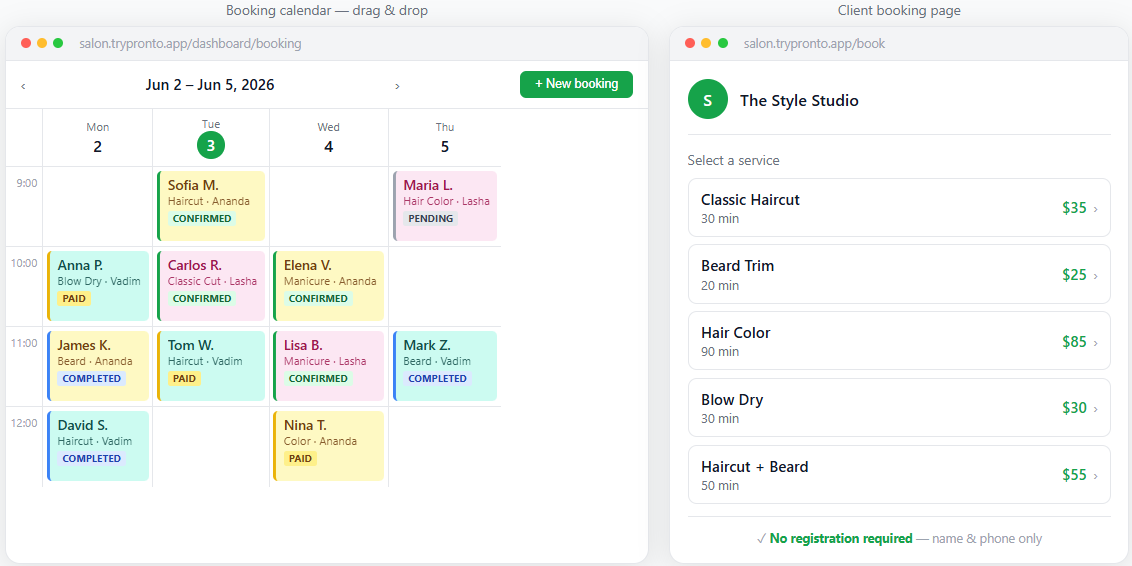
In Pronto, services and prices live in one list, so changing a price updates what new clients see on your booking page straight away. One thing to watch: at checkout Pronto fills in the service's current list price, so for an appointment booked before the change, check the amount before you charge. On the Pro and Agency plans, analytics list your top services with their bookings and revenue, which helps you see which services carry the business and are worth raising first. Notes and tags on a client's profile are a good place to record "old price until 31 December" so whoever is at the desk honors it. And to reward regulars without cutting list prices, the loyalty program (Pro and Agency) gives points based on what clients spend.
How much should you raise your prices?
Most salon pricing guides suggest 5–10% a year. After two or more years without a change you may need 15–20%, which is easier to introduce in two steps six months apart. Round to clean numbers and raise your most-requested services first.
How much notice should you give clients about a price increase?
Four to six weeks for regular clients, and six to eight weeks for a larger increase. Tell your regulars in person first, send one message to everyone four weeks before, and a short reminder two weeks before.
Should you raise prices for existing clients or only for new ones?
New clients pay the new price from their first booking. Existing clients pay it after your notice period, ideally with a short soft landing such as one more visit at the old price. Raising prices only for new clients leaves you maintaining two price lists.
How many clients will you lose after a price increase?
It depends on your margin and how you handle it. At a 50% margin, a 10% increase breaks even if you lose up to about one client in six. One vendor's guide reports fewer than 5% of regular clients leaving after a well-handled increase.
What do you say when a client complains about the new price?
Acknowledge the change, repeat the date and the new price, say what it covers and offer to book before the date at the current price. Do not apologize and do not discount on the spot.
How often should you raise prices?
Review them once a year on a fixed date and make small changes instead of rare large ones. A predictable annual date makes an increase feel routine rather than personal.
See how services and prices work in Pronto
Open the live demo, a working Pronto account with sample data and no sign-up. Look at the services list and the public booking page your clients see.
Try the live demo →